Pacing RPG sessions with maps: which scenes need one and for how long
- By
- expenseforge.com
- Published
- Reading time
- 5 min
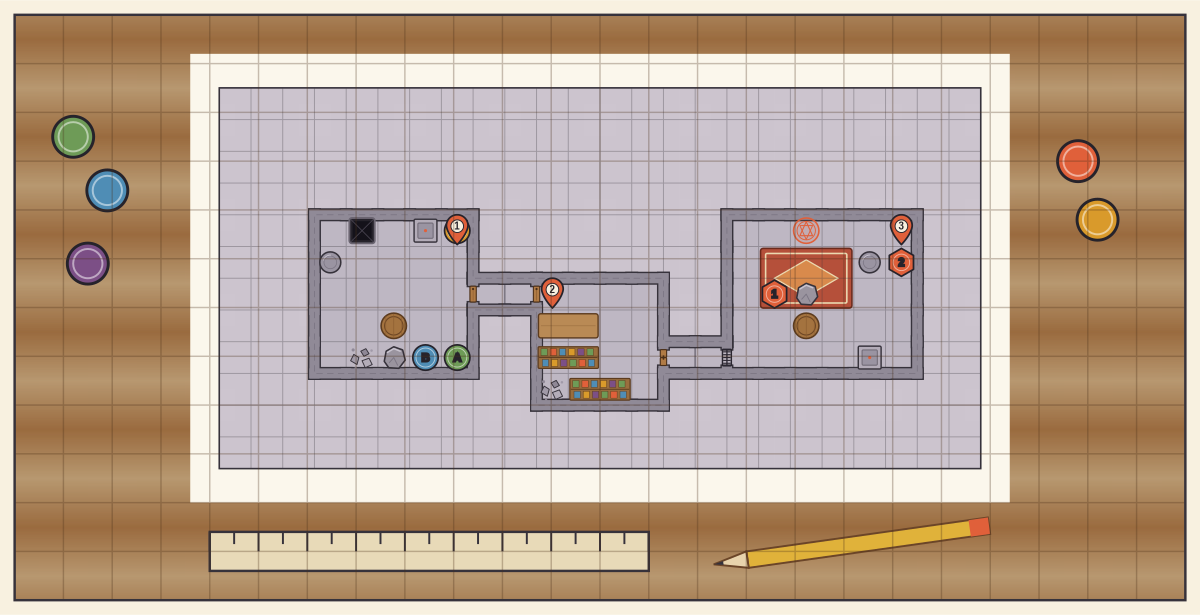
A map on the table slows time. Every move is counted, every figure is placed, and a scene that could take ten minutes of talk stretches into an hour. For a tense scene, that slowdown is the point. Spread across every scene, it turns an evening into a series of boards.
Read on to decide which scenes get a map, how big and detailed it should be for the minutes you have, and how to alternate close-up map scenes with faster talk so the evening has a shape.
Test whether a scene needs a map
Ask three questions. Does position matter, through distance, cover or a blocked path? Are three or more figures acting at once in different places? Will the players want to plan a route before they commit? Two or more yes answers call for a full map. One yes calls for a quick sketch. No answers mean the scene runs on talk.
| Scene | Map needed | Reason |
|---|---|---|
| Negotiation across a table | No | Position adds nothing to the conversation |
| Fight in a room with obstacles | Yes | Cover, reach and blocked paths matter |
| Chase through narrow streets | Simple map | Routes and distance matter, detail does not |
| Travel over several days | No | An overview or a few lines of narration is enough |
| Searching one room | Quick sketch | Only a few positions matter |
Break the rule when a scene is the emotional center of the evening. A conversation in a small room can gain from a map when the group needs to see who stands near the door and who blocks it. The test is whether the map answers a question the players are already asking.
Mark each planned scene as map, sketch or talk before the session starts, so the choice is made calmly and not in the middle of play. Planning which scenes get a map is part of preparing the session. Dungeon room sizes shows how the size of a room shapes the length of a scene played in it.
Set the map's size by the time you have
Map size and scene length move together. A rough planning assumption helps: with five players and three creatures, a round has eight turns. At about one minute a turn, a round takes 8 minutes, and a four round scene takes 32 minutes. Those figures are a starting point, not a measurement, so adjust them after a session or two.
Now look at the map. A room of 12 by 12 squares is 60 by 60 ft (18 by 18 m) at 5 ft (1.5 m) per square. Figures can cross it in a couple of moves, and the scene gets to its point quickly. A hall of 40 by 40 squares takes several turns to cross, and the scene stretches with it.
Choose the smaller map when the scene is a stop on the way, and the larger one when the space is the subject. Choosing a grid size explains how to settle the columns and rows. In the Map Builder, the grid runs from 6 to 60 columns and rows, so a short scene and a sprawling one are both easy to build.
Alternate tight scenes and loose scenes
Rhythm comes from contrast. A map scene is tight: every move counts, and attention narrows. A talking scene is loose: time passes quickly and attention spreads out. Two tight scenes in a row tire the group. Two loose scenes in a row leave it restless.
Place the tight scene where the story is tightest, and leave room on either side. When the evening has only one map scene, consider putting it in the middle, with an opening scene that sets the question and a closing scene that follows its answer.
Prepare maps so setup takes a minute
Setup is part of pacing. A map that takes five minutes to lay out is five minutes of silence, and the group's attention drifts. Aim to have a map on the table in about a minute.
- Print and trim ahead. A map that needs cutting at the table is not ready. Printing at true scale covers how to prepare a sheet so it lands at the right size.
- Keep pieces together. One envelope per map, with tokens and furniture inside, saves a search.
- Know the map. Read it once before the session, so you can say where the door is without hunting.
- Sketch quickly. A room of four lines and two marks drawn in a minute is better than a perfect map that arrives late.
Reuse speeds this up. A small library of maps that already fit your scenes means you pick and place instead of build. Organizing a reusable map library shows how.
End a map scene when its question is answered
Every map scene should carry one question: can the group reach the exit before the door closes, hold the bridge, or find the hidden room? Say the question aloud when the scene starts, so players know what the scene is for. When it is answered, the scene is done, even if turns remain.
Give the question a visible clock. A corridor of 12 squares that takes the group 4 rounds to cross, with a door that closes after 6 rounds, makes a clear tension without extra rules. The Map Builder's start and exit markers help here, because they show the goal at a glance.
Watch for signs that a scene is dragging: players looking at their phones, repeated rounds with no change, or a question that has already been answered. Wrap the board, narrate the rest in a sentence or two and move on. A scene that ends a little early leaves energy for the next one.
Common mistakes
- Mapping every scene. A map for each conversation turns the evening into a board game. Keep maps for scenes where position matters.
- Oversized maps for short scenes. A 40 by 40 square map for a quick encounter makes the group cross empty floor. Match the size to the question.
- Back-to-back map scenes. Two long boards in a row wear people out. Put a talking scene between them.
- Slow setup. Cutting, sorting and searching at the table kills momentum. Prepare in advance.
- Playing to the last turn. When the question has been answered, stop and narrate the rest.
FAQ
How can a scene be recognized as dragging?
Look for repeated rounds with no change, players drifting to other tasks, and turns that take longer each time. If the scene's question is already answered, end it. If not, add a change: a new arrival, a closing door or a shift in the space, so the next round differs from the last.
Can a fight run without a map?
Yes, when positions matter little. A small group in one room can run on description alone, with a simple note of who is near whom. A map becomes useful when cover, distance or a blocked path starts to matter, or when players begin to disagree about where everyone is standing.
How long should a map scene last?
Plan about 30 to 45 minutes for a full scene with five players and a handful of creatures. If a scene is heading past an hour, look for a way to end it sooner, or split it into two parts with a moment of talk in between.
Sources
- Schell, Jesse. The Art of Game Design: A Book of Lenses. 3rd ed. CRC Press, 2019. For lenses that help judge whether a scene serves the experience you want at the table.
- Csikszentmihalyi, Mihaly. Flow: The Psychology of Optimal Experience. Harper & Row, 1990. For the idea that attention is best held when challenge and skill stay in balance.
- Adams, Ernest. Fundamentals of Game Design. 3rd ed. New Riders, 2014. For general guidance on pacing and structure in games.
- Hunicke, Robin, Marc LeBlanc, and Robert Zubek. "MDA: A Formal Approach to Game Design and Game Research." Proceedings of the AAAI Workshop on Challenges in Game AI, 2004. For a way to think about how rules and tools shape the feel of play.